
How do you engage young people in a debate about their future when so many feel shut out of the traditional levers of change? At the Labour Party Conference in Liverpool, Young Citizens’ youth ambassadors (Georgia-Mae, Mollie and Ahmed) put that question to a panel of parliamentarians and sector leaders, pitching their ideas for giving young people a real stake in democracy. One of them, Ahmed, reflects on the day and argues that the problem isn’t apathy, but what happens after young people speak up.
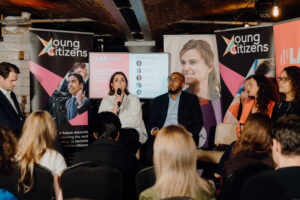
Walking into the Young Citizens Youth Pitch event, I felt a mixture of nerves and excitement. I was excited to have the opportunity to speak about something I strongly believe in: young people having a meaningful role in the decisions that affect us. But I was also nervous. My speech was going to be delivered in front of a panel of experts who make decisions that affect millions of people every day. I wondered whether my message would receive the focus and consideration it deserved.
“Young people are interested in making change; sometimes they simply do not feel that there is a meaningful route for them to do so.”
My main message was simple: young people need to be involved in decisions that affect them. That involvement should not disappear simply because decision-makers disagree with us. In fact, disagreement is part of our democracy. What matters is that young people are told what happened to their ideas and why a particular decision was made. If our views are listened to but never acted upon, or if we never hear what happened afterwards, it can create the feeling that speaking up does not make a difference.
One of the most interesting parts of the event was hearing ideas from other young people. The idea of a democratic passport, put forward by fellow young ambassador Georgia-Mae, particularly stood out to me. The idea was discussed alongside other proposals, including giving children and young people more opportunities to learn about politics in school.
“Disagreement is part of our democracy. What matters is that young people are told what happened to their ideas.”
What made this especially powerful was that these ideas were not simply discussed and then forgotten. Key figures, including Natasha Irons MP; Bashir Ibrahim of My Life My Say; Ashley Hodges, CEO of Young Citizens; and Olivia Field of the Jo Cox Foundation, were involved in considering and voting on the ideas.
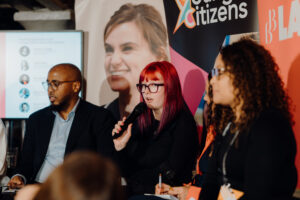
What struck me most was the scale of the voices in the room. This was not simply one young person from Manchester wanting to make a difference. Young people from different parts of England, and ultimately young people across the world, have ideas, concerns and ambitions about the society they live in. We are often told that young people are not interested in politics, but experiences like this show something different. Young people are interested in making change; sometimes they simply do not feel that there is a meaningful route for them to do so.
For me, meaningful participation means being consulted on decisions that affect us, whether directly or indirectly. Our opinions should be considered and, most importantly, we should receive a response, whether that response is agreement or disagreement. That is democracy. Young people need to know that these opportunities exist, and this can be promoted through schools, colleges, youth organisations and social media.
“Your age does not make your opinion irrelevant.”
The event also gave me hope. Young people may not be listened to at the level I would want, but this is a start. Seeing so many young people willing to speak, challenge ideas and propose solutions showed me that the desire to participate is there.
If you are a young person reading this, the one thing I would want you to take away is that you can influence both the present and the future. Your age does not make your opinion irrelevant. Whether it is through a youth organisation, a school council, a campaign, a consultation or simply speaking up about an issue you care about, your voice has the potential to create change.
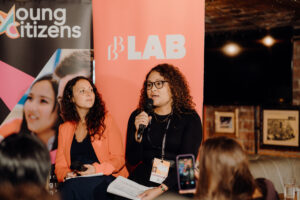
Young people are not apathetic. We are disconnected from politics, and we need to rebuild that connection. But rebuilding it cannot be the responsibility of young people alone. Decision-makers must be willing to listen, respond and give young people a genuine place at the table.
About Young Citizens
Founded in 1989 by Lord Phillips OBE, Young Citizens helps state schools deliver active citizenship education so young people are equipped with critical knowledge and skills on our democracy, law, media and the economy to participate in their communities and society. Each year, the charity reaches over 300,000 young people across thousands of UK schools through its lessons, training and immersive experiences including Mock Trials, youth-led social action Make a Difference Challenge and The Big Legal Lesson.
Help young people get a real stake in democracy
Ahmed and our youth ambassadors have made the case: young people want to take part, but too often there is no meaningful route for them to do so. With Votes at 16 on the way, Young Citizens is building those routes, and we are looking for partners to help shape our 2027 programmes and special projects.
Are you a Young Citizens alumnus or a legal professional? You can also volunteer with us.